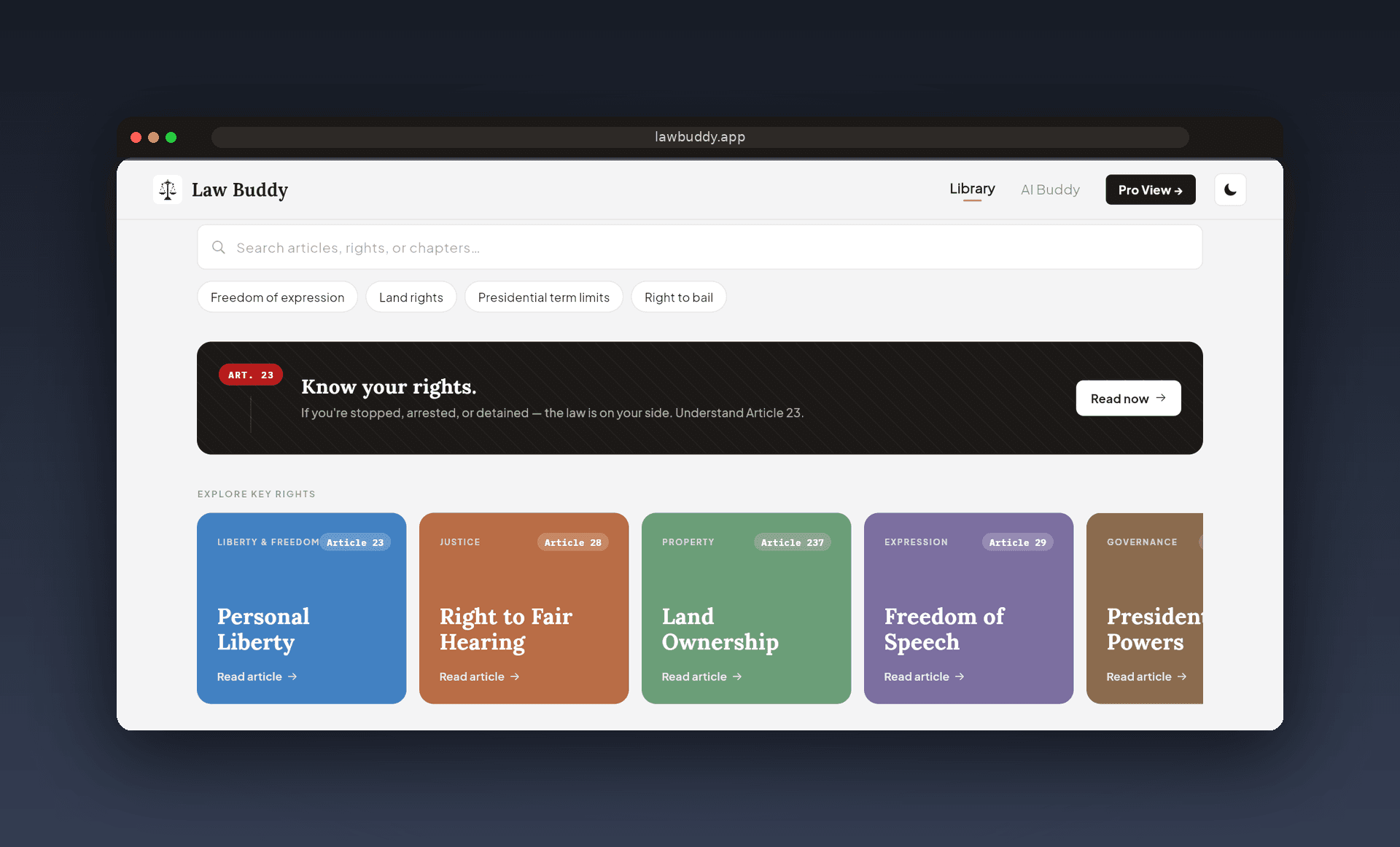
Legal information should not require a stable internet connection to access. In Uganda, where large swaths of the population live in areas with unreliable connectivity, that assumption is a barrier — and Law Buddy was built to remove it.
The constraint that defined the architecture
The 1995 Ugandan Constitution is the core of the app. It is a fixed document: it does not change day-to-day, it does not require a live API, and it can be bundled entirely. That single fact made offline-first not just feasible but the obvious right choice.
The design principle: if you download the app once, it should work forever without touching the network.
How offline storage works
Law Buddy uses the browser's built-in storage APIs — specifically a combination of service workers and IndexedDB — to cache the entire constitution on first load. After that initial fetch:
- Service workers intercept all network requests and serve from cache.
- IndexedDB stores the searchable article data, enabling full-text search without any server round-trips.
- The app shell (UI chrome, fonts, styles) is pre-cached at install time.
The result: after a single online visit, the app is fully functional on a plane, in a rural area, or anywhere with zero signal.
Structuring 275 articles for readability
The 1995 Ugandan Constitution has 287 articles across 19 chapters, plus schedules. Dumping this as raw text would be unusable. Law Buddy structures it as:
- Chapter navigation (sidebar/drawer)
- Article-level deep links (shareable URLs like
/article/29for Freedom of Expression) - Search that matches article titles and full text
Each article is stored as a discrete record in IndexedDB, which makes both navigation and search fast regardless of connection state.
What I learned
Building without a network dependency forced a different kind of discipline. Every feature had to answer the question: does this work offline? That filter eliminated a lot of unnecessary complexity and kept the bundle lean.
The other lesson: accessibility and offline availability are deeply related. Offline-first is, in many contexts, just another word for accessible.
Live: uglawbuddy.vercel.app